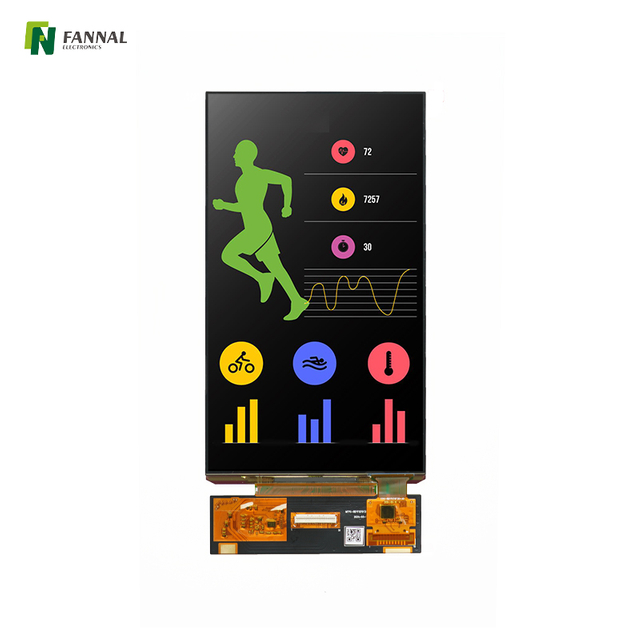
An AMOLED (Active Matrix Organic Light-Emitting Diode) display is a type of OLED display in which every pixel emits its own light and is individually controlled by a thin-film transistor (TFT) backplane. Unlike LCD technology, AMOLED displays do not require a backlight, allowing them to achieve true black levels, extremely high contrast, vibrant colors, and ultra-fast response times.
Because each pixel can be switched on or off independently, AMOLED technology delivers excellent image quality while enabling thinner display modules, flexible form factors, and improved power efficiency when displaying dark content.
Originally adopted in flagship smartphones, AMOLED technology is now widely used in wearables, automotive displays, medical equipment, premium laptops, and other applications where visual performance is a priority.
How Does an AMOLED Display Work?
AMOLED combines two technologies into a single display architecture.
The first is the OLED layer, which generates light directly through organic emissive materials. When electrical current passes through these organic compounds, they emit red, green, or blue light without requiring an external light source.
The second is the active-matrix TFT backplane. Every pixel is connected to one or more thin-film transistors that precisely regulate the electrical current flowing through the OLED materials. This active control enables high-resolution displays with accurate brightness adjustment, fast refresh rates, and stable image quality.
A simplified AMOLED structure typically includes:
Cover glass
Touch sensor (optional)
Polarizer
OLED emissive layers
TFT active-matrix backplane
Flexible or glass substrate
Unlike an LCD, where a single backlight illuminates the entire panel, AMOLED pixels generate light independently. When a pixel is turned off, it emits no light at all, producing true black and significantly improving perceived contrast.
This pixel-level illumination also enables technologies such as Always-On Display, HDR content, and local brightness control that would be difficult to achieve with conventional backlit LCDs.
AMOLED vs LCD: What's the Difference?
Although both technologies are widely used across consumer and industrial products, AMOLED and LCD use fundamentally different methods to produce images.
LCD panels rely on a backlight that continuously illuminates the display. Liquid crystal molecules control how much light passes through each pixel, but they cannot completely block the backlight. As a result, black areas often appear dark gray rather than truly black.
AMOLED displays eliminate the backlight entirely. Every pixel acts as an independent light source, allowing individual pixels to switch completely off when displaying black. This difference influences nearly every aspect of display performance.
AMOLED is often selected when image quality, contrast, industrial design, or premium user experience is the highest priority. TFT LCD remains the preferred choice for many i ndustrial products because of its lower cost, long service life, excellent outdoor brightness options, and immunity to burn-in.
The best choice depends on the application's operating environment, product lifetime, brightness requirements, and budget rather than on a single specification.
Advantages of AMOLED Displays
The widespread adoption of AMOLED technology is driven by its unique display architecture rather than incremental improvements over LCD. By allowing every pixel to emit its own light, AMOLED delivers several advantages that are difficult or impossible for traditional backlit displays to achieve.
True Black and Exceptional Contrast
The most recognizable advantage of AMOLED displays is their ability to produce true black.
When a pixel displays black, it simply turns off completely instead of attempting to block light from a backlight. Since no light is emitted, black areas remain truly black regardless of ambient lighting conditions.
This pixel-level light control creates an exceptionally high contrast ratio, making bright objects appear more vivid while preserving subtle details in dark scenes. The result is improved readability, greater perceived image depth, and more realistic visual performance for both multimedia and professional applications.
Wide Color Gamut and Accurate Color Reproduction
AMOLED displays can reproduce a broad range of colors while maintaining high saturation and excellent color consistency.
Many premium AMOLED panels support wide color spaces such as DCI-P3, enabling richer reds, deeper blues, and smoother color gradients than conventional LCD panels. Combined with precise pixel-level brightness control, this allows images and videos to appear vibrant without sacrificing accuracy.
Applications including medical imaging, automotive interfaces, professional content creation, and premium consumer electronics all benefit from AMOLED's ability to deliver consistent, high-quality color reproduction.
Ultra-Fast Response Time
Unlike liquid crystal molecules that require time to change orientation, OLED materials respond almost instantly when electrical current changes.
Typical AMOLED response times are measured in microseconds rather than milliseconds, dramatically reducing motion blur and ghosting during fast-moving content.
Fast response is particularly valuable for gaming displays, virtual reality devices, automotive interfaces, and industrial equipment where rapidly changing visual information must remain clear and responsive.
Wide Viewing Angles
Because light is emitted directly from each pixel, AMOLED displays maintain excellent image quality even when viewed from extreme angles.
Brightness, contrast, and color remain relatively consistent without the color inversion or brightness loss commonly associated with certain LCD technologies.
This characteristic improves usability in collaborative workstations, public information displays, vehicle cabins, and medical equipment where users may view the screen from different positions.
Thin, Lightweight, and Flexible Design
Without a separate backlight unit, AMOLED modules can be significantly thinner and lighter than comparable LCD modules.
The simplified optical stack also enables flexible substrates that support curved, foldable, and even rollable display designs. These characteristics have driven the rapid adoption of AMOLED technology in smartphones, wearable devices, automotive interiors, and other products where industrial design plays an important role.
Improved Power Efficiency for Dark Interfaces
Power consumption in an AMOLED display depends largely on the brightness of individual pixels.
When displaying dark user interfaces or predominantly black content, many pixels remain completely off, reducing overall power consumption compared with LCD displays whose backlights remain continuously illuminated.
For devices that frequently use dark mode or Always-On Display features, AMOLED can significantly improve battery life. However, power consumption increases as more bright pixels are displayed, meaning AMOLED is not always more energy efficient than LCD under every operating condition.
Limitations of AMOLED Displays
Although AMOLED technology delivers outstanding image quality, it also introduces several engineering trade-offs that should be considered during product development. The most appropriate display technology depends on the application's operating environment, expected service life, power budget, and cost objectives.
Organic Material Aging
Unlike LCDs, AMOLED displays rely on organic emissive materials that gradually degrade over time. As these materials age, maximum brightness slowly decreases and color characteristics may shift.
Modern AMOLED panels use improved organic compounds and compensation algorithms to slow this aging process, allowing many commercial products to operate reliably for years. However, applications requiring exceptionally long service life or continuous operation should still consider lifetime requirements during display selection.
Burn-in and Image Retention
Because each pixel ages according to how much it is used, static interface elements such as navigation bars, status icons, or logos may eventually produce uneven aging across the display.
This phenomenon, commonly known as burn-in, is more likely in applications where the same high-brightness content remains on screen for extended periods.
Most modern AMOLED displays include mitigation techniques such as:
Pixel shifting
Automatic brightness adjustment
Pixel refresh routines
UI design optimization
These technologies significantly reduce burn-in risk during normal use, but applications with permanently static interfaces should still evaluate whether LCD technology may be a better long-term choice.
Higher Cost
AMOLED manufacturing requires complex deposition processes, specialized materials, and lower production yields than conventional TFT LCD manufacturing.
Although prices have declined substantially in recent years, AMOLED panels generally remain more expensive than comparable LCD solutions, particularly for industrial products with lower production volumes.
For applications where cost is the primary consideration and premium image quality is unnecessary, TFT LCD often provides a more economical solution.
Power Consumption Depends on Display Content
AMOLED displays are frequently described as energy efficient, but actual power consumption depends on what is displayed.
Dark interfaces require relatively little power because many pixels remain off. Conversely, bright images or white backgrounds require nearly every pixel to emit light simultaneously, increasing power consumption.
Applications dominated by bright user interfaces may therefore see little or no efficiency advantage over LCD technology.
Types of AMOLED Displays
AMOLED technology continues to evolve as manufacturers optimize performance, efficiency, and mechanical flexibility for different applications.
RGB AMOLED
RGB AMOLED uses individual red, green, and blue organic subpixels to generate color directly.
This architecture offers excellent color accuracy and image quality, making it suitable for premium smartphones, professional displays, and applications requiring precise color reproduction.
PenTile AMOLED
PenTile AMOLED uses a different subpixel arrangement to improve manufacturing efficiency and extend panel lifetime.
Rather than assigning a complete RGB subpixel set to every pixel, neighboring pixels share certain subpixels while image processing algorithms maintain perceived image quality.
Many modern smartphones successfully use PenTile AMOLED displays with little noticeable difference during normal viewing.
Flexible AMOLED
Flexible AMOLED replaces rigid glass substrates with flexible materials, allowing displays to bend or curve.
This technology enables curved dashboards, wearable devices, foldable smartphones, and other products that require innovative industrial design.
Flexibility also improves resistance to mechanical shock compared with traditional rigid display structures.
Instead of operating continuously at a fixed refresh rate, LTPO displays can dynamically adjust refresh rates according to displayed content.
For example, a smartphone may reduce its refresh rate to 1 Hz while showing a static clock, then increase to 120 Hz when scrolling or gaming. This significantly improves battery life without compromising user experience.
Industrial Applications of AMOLED Displays
Although AMOLED technology is widely associated with smartphones, it has become increasingly important across professional industries where image quality and advanced user interfaces are essential.
Medical Equipment
Medical monitors, portable diagnostic devices, and imaging systems benefit from AMOLED's high contrast, wide viewing angles, and excellent grayscale performance.
Clear visualization of subtle image details can improve usability in diagnostic and clinical environments.
Automotive Displays
Modern vehicle interiors increasingly rely on digital instrument clusters and infotainment systems.
AMOLED displays enable curved dashboard designs, vibrant graphics, and excellent visibility from multiple viewing positions while supporting premium interior aesthetics.
Industrial Human-Machine Interfaces (HMI)
Industrial equipment with advanced graphical interfaces can benefit from AMOLED's high contrast and fast response.
However, long operating hours and static interface elements require careful consideration of brightness management and burn-in mitigation during system design.
Wearable Devices
Smartwatches and other wearable products are ideal candidates for AMOLED technology because of their compact size, thin profile, and support for Always-On Display functions.
Dark user interfaces also help maximize battery life.
Consumer Electronics
Premium smartphones, tablets, laptops, portable gaming devices, and AR/VR systems continue to drive AMOLED adoption thanks to its outstanding visual quality and design flexibility.
How to Choose an AMOLED Display
Selecting an AMOLED display involves much more than choosing a screen size or resolution. Engineers should evaluate the display as part of the complete product architecture.
Important considerations include:
Brightness Requirements
Determine whether the display will operate indoors, outdoors, or under direct sunlight.
Outdoor applications may require high-brightness AMOLED panels combined with optical bonding and anti-reflective surface treatments.
Operating Environment
Temperature, humidity, vibration, and continuous operating hours all influence long-term display reliability.
Industrial and automotive applications often require wide-temperature components and enhanced environmental durability.
Applications requiring operation with gloves, water, or thick cover glass should verify touch controller performance and firmware capabilities during system design.
Optimizing the complete optical stack often has a greater impact on user experience than selecting the display panel alone.
Product Lifetime and Supply
Industrial equipment typically remains in production much longer than consumer electronics.
Choosing a supplier capable of long-term supply, customization, and engineering support can help reduce redesign costs throughout the product lifecycle.
Future of AMOLED Technology
AMOLED technology continues to advance beyond smartphones as manufacturing processes improve and production costs decline.
Several developments are expected to shape the next generation of AMOLED displays.
Adaptive refresh technologies such as LTPO will become more common, reducing power consumption while maintaining smooth visual performance.
Tandem OLED structures are improving brightness, efficiency, and operational lifetime by stacking multiple emissive layers within a single display.
Flexible and foldable displays will continue expanding into automotive, industrial, and commercial applications as mechanical reliability improves.
At the same time, advances in encapsulation materials, OLED chemistry, and driver technologies are extending display lifetime and reducing the risk of image retention.
Although emerging technologies such as MicroLED continue to receive attention, AMOLED is expected to remain one of the leading premium display technologies for the foreseeable future due to its mature manufacturing ecosystem and outstanding visual performance.
FAQ
Q1. Is AMOLED better than TFT LCD?
Neither technology is universally better. AMOLED offers superior contrast, true blacks, wider viewing angles, and thinner designs, while TFT LCD generally provides longer service life, lower cost, higher peak brightness for some outdoor applications, and no risk of burn-in. The best choice depends on the application's requirements rather than on a single specification.
Q2. Can AMOLED displays suffer from burn-in?
Yes. Because AMOLED pixels age according to usage, prolonged display of static content may eventually cause uneven aging. Modern panels significantly reduce this risk through pixel shifting, compensation algorithms, automatic brightness management, and pixel refresh functions, making burn-in much less common during typical use.
Q3. Are AMOLED displays suitable for industrial equipment?
Yes, provided the application benefits from high image quality and system designers consider factors such as operating temperature, static interface elements, lifetime expectations, and environmental conditions. Many industrial, medical, and automotive products successfully integrate AMOLED displays.
Q4. Do AMOLED displays always consume less power than LCDs?
Not necessarily. AMOLED displays are highly efficient when displaying dark content because inactive pixels consume almost no power. However, displaying bright or predominantly white content requires more pixels to emit light, which can increase power consumption. Actual efficiency depends on the application's user interface and usage patterns.
Q5. Can AMOLED displays be used outdoors?
Yes. High-brightness AMOLED panels combined with optical bonding and anti-reflective surface treatments can provide excellent outdoor readability. However, brightness specifications, ambient lighting conditions, and thermal management should all be evaluated during display selection.
Q6. How long does an AMOLED display last?
The operational lifetime of an AMOLED display depends on panel quality, brightness settings, operating temperature, and usage patterns. Modern AMOLED technology has significantly improved durability, and many commercial panels can operate reliably for years under normal conditions. For products requiring exceptionally long service life, lifetime specifications should be reviewed alongside environmental requirements during the design process.
Technical requirements rarely stop at the LCD panel itself. Depending on the application, the display may also require customized brightness, interface, touch performance, cover glass, optical bonding, FPC, operating temperature, or mechanical integration.
FANNAL provides customized TFT LCD and AMOLED display solutions for industrial, medical, automotive, outdoor, and embedded applications, with display, touch, and optical integration support.