FN1210P001B
FANNAL
12.1
306.75 (H) × 197 (V) × 2.5 (T)
-30~85
-40~85
261.92 × 164
G+G
IIC
| Availability: | |
|---|---|
| Quantity: | |
The cover glass uses an anti-glare (AG) surface treatment to reduce visible reflections from ambient light. This can be useful for control panels and equipment installed under overhead lighting or in locations where the viewing angle and surrounding light are not fully controlled.
The panel is specified to operate from -30°C to +85°C, covering a considerably wider temperature range than many standard touch panels. This makes it a candidate for equipment exposed to cold starts, elevated enclosure temperatures, or significant temperature changes during operation.
The G+G construction uses a glass sensor beneath the cover glass and supports 10-point multi-touch. It provides a rigid front surface suited to equipment interfaces where touch interaction is part of the regular operating workflow.
The 1.8 mm cover glass is chemically strengthened and has a minimum surface hardness of 6H. The combination is intended for repeated touch interaction while providing a solid front surface for equipment integration.
This is a touch panel rather than a complete touch display, so the LCD can be selected separately according to the project's resolution, brightness, interface, and mechanical requirements. This is useful when the display and touch specifications need to be developed independently.
The touch panel provides 82% minimum light transmittance, helping limit the optical loss introduced when the panel is placed over an LCD.
Item / Property | Specification / Requirement | Unit |
Active Size | 12.1 (Diagonal) | Inch |
Outline Size | 306.75 (H) × 197 (V) × 2.5 (T) | mm |
View Area | 261.92 × 164 | mm |
Structure | G+G | - |
Cover Lens Thickness | 1.8 (Chemically strengthened, AG) | mm |
ITO Glass Thickness | 0.55 | mm |
Surface Hardness | ≥ 6H | - |
Surface Treatment / AG | AG (Anti-Glare) | - |
Transparency / Light Transmittance | 82% Min | - |
Touch / Driver IC | Microchip | - |
Detect Points / No. of Touch | 10 | - |
Interface | IIC | - |
IIC Address | 0x4a | - |
Operating Temperature | -30 ~ +85 | °C |
Storage Temperature | -40 ~ +85 | °C |
The 12.1-inch format provides enough working area for machine controls, status screens, parameter adjustment, and other operator functions. The wide temperature range is particularly relevant when the control panel is installed directly on industrial equipment.
For equipment installed in semi-outdoor areas, workshops, transportation facilities, or locations subject to temperature swings, the -30°C to +85°C operating range provides useful environmental headroom. The AG surface can also help with reflections from surrounding light.
The larger touch surface and multi-touch capability allow interfaces to combine navigation, parameter entry, and graphical controls without relying entirely on physical buttons.
A 12.1-inch panel can accommodate information-dense interfaces such as measurement data, charts, configuration menus, and control functions. The standalone design also allows the touch layer to be matched with a project-specific LCD.
The panel can be integrated into custom HMI equipment where the mechanical structure, LCD, and touch panel are developed as separate components rather than using an off-the-shelf monitor.
To meet diverse integration needs, we offer extensive customisation for you, including:
• Size range: 1.77" to 15.6"
• Trusted panel partners: BOE, INNOLUX, JDI, Hannstar, CTC, TCL, and TIANMA.
• Panel types: IPS / TN / LTPS
• Operation Temperature: Industrial (-20 ~ 70°C), Automotive (-30 ~ 85°C)
• Tailored shape, length, and PIN definitions for full compatibility.
• EMI shielding and circuit optimisation.
• Supports multiple conversions: SPI, MCU, RGB, MIPI, LVDS, EDP
• Module material options: metal/plastic/metal–plastic integration
• High brightness up to 30,000 cd/m², ideal for outdoor or industrial use.
• Long lifetime up to 50,000 hours.
• Options: RGB / VGA / HDMI / LVDS / DVI / Type-C
• Fully compatible with custom TFT and LCD modules.
• Optimised design for stable image transmission and performance.
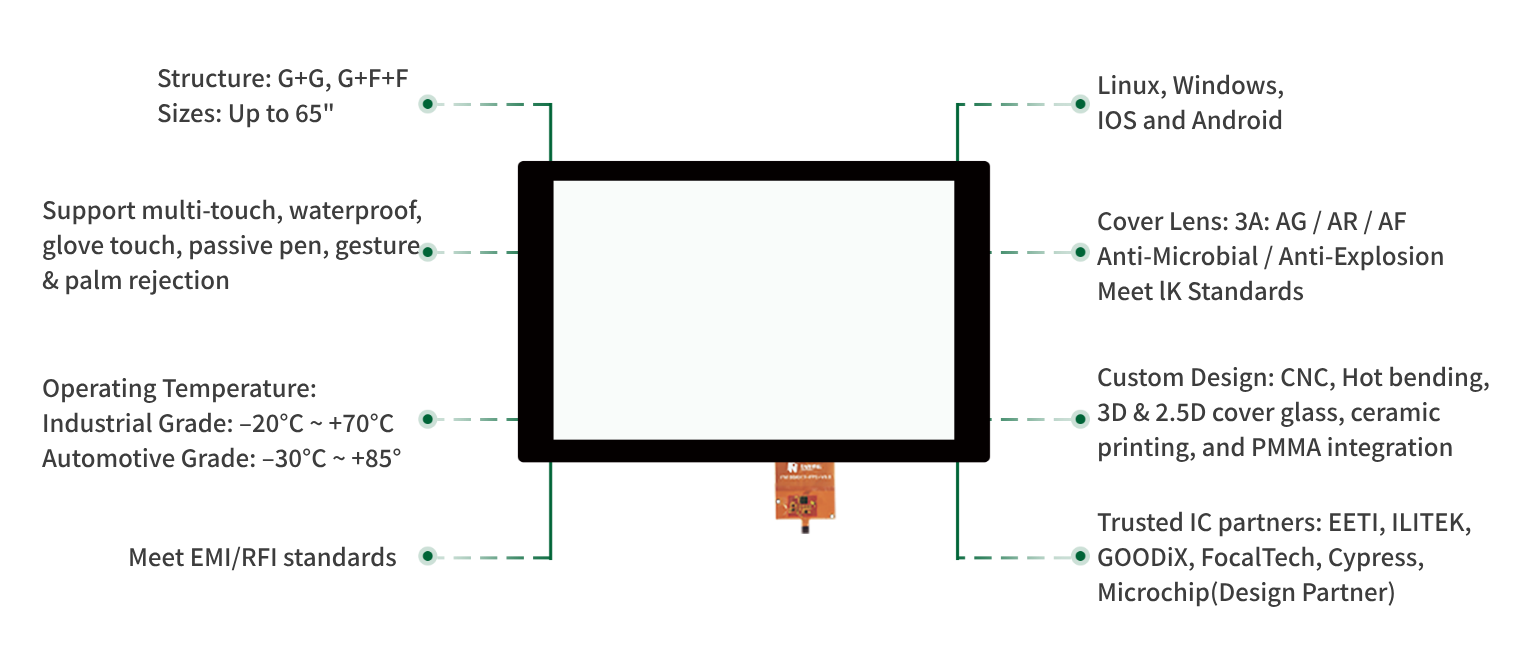
• Available Sizes: Up to 65"
• Structure Options: G+G, G+F+F, designed for industrial and automotive applications
• Touch Functions: Supports multi-touch, waterproof, glove touch, passive pen, gesture & palm rejection
• Operating Temperature:
Industrial Grade: –20°C ~ +70°C
Automotive Grade: –30°C ~ +85°
• Touch tuning and firmware optimization provided by FANNAL (in-house FW design)
• Trusted IC partners: EETI, ILITEK, GOODiX, FocalTech, Cypress, Microchip(FANNAL's Design Partner)
• High Reliability: Excellent anti-interference and long-term stability
• EMC Design: Full electromagnetic compatibility engineering to meet EMI/RFI and industrial standards
• Material Options:
Glass: 0.55mm–10.0mm
PMMA: 0.5mm–3.0mm
PC: 0.1mm–1.0mm
• Custom Design: CNC, Hot bending, 3D & 2.5D cover glass, ceramic printing, and PMMA integration
• Surface Treatments:
3A: AG / AR / AF
Anti-Microbial / Anti-Explosion
Optical Bonding | Size Range | Notes |
OCA | Up to 15.6” | Two fully automated production lines for high-volume manufacturing |
LOCA / OCR | Up to 32” | Excellent for high contrast and durability |
Silicone | Up to 32” | Ideal for rugged, large-size industrial applications |
No. Anti-glare and sunlight readability address different problems. AG treatment reduces surface reflections, but it does not increase the display's luminance. If the equipment will be exposed to direct sunlight, the selected LCD should be evaluated separately for luminance, optical stack, and readability.
A standalone panel gives the system designer more freedom to select the LCD separately. This can be useful when an existing display needs to be retained, when the required resolution is project-specific, or when the mechanical and touch requirements are being developed independently.
No. These specifications apply to the touch panel itself. If the panel is integrated with an LCD, the LCD, bonding materials, controller, adhesives, and other components should each be checked against the intended operating environment.
Potentially, yes. For a custom integration, the LCD active area, touch viewing area, outline dimensions, cover glass geometry, mounting method, and interface requirements need to be matched. FANNAL can evaluate the touch panel and display as an integrated solution when the standard configuration does not match the equipment design.