FN0340D004A
FANNAL
3.4
110.0(H) x 110.0(V) x 8.5(T)
-20~70
-30~80
88.2(H) x 88.2(V)
G+G
800×800
IIC
550
| Availability: | |
|---|---|
| Quantity: | |
Item | Specification | Unit | Remark |
Display Specifications | |||
Active Size | 3.4 (Diagonal) | Inch | Round/Square |
Resolution | 800 * 800 | - | |
TFT Interface | MIPI | - | |
TPM Surface Luminance | 550 (Typ.); 440 (Min) | cd/m² | |
Uniformity | 80% Min | - | |
TFT Power Supply | 2.8 | V | |
TFT Part Number | FN0340D004A | - | |
Touch Specifications | |||
Touch Structure | G+G | - | Glass + Glass |
Touch Controller (IC) | FT5426G | - | |
Touch Points | 5 | - | |
Touch Interface | IIC | - | |
Touch Power Supply | 3.3 | V | |
Transmittance | 85% Min | - | |
Sensor Channels | TX13 * RX13 | - | |
Mechanical & Construction | |||
TPM Outline Size | 110.0(H) x 110.0(V) x 8.5(T) | mm | |
View Area | 88.2(H) x 88.2(V) | mm | |
Cover Thickness | 2.9 (CS) | mm | Chemical Strengthening |
Sensor Thickness | 0.55 | mm | |
Surface Hardness | ≥ 7H | - | 750g load |
Bonding Type | Optical Bonding | - | OCA Material |
Unmarked Tolerance | ±0.3 / ±1° | mm/° | |
Environmental Reliability | |||
Operating Temperature | -20 ~ 70 | °C | |
Storage Temperature | -30 ~ 80 | °C | |
Humidity | 10% ~ 90% | - | |
Compliance | RoHS-2.0, REACH | - | |
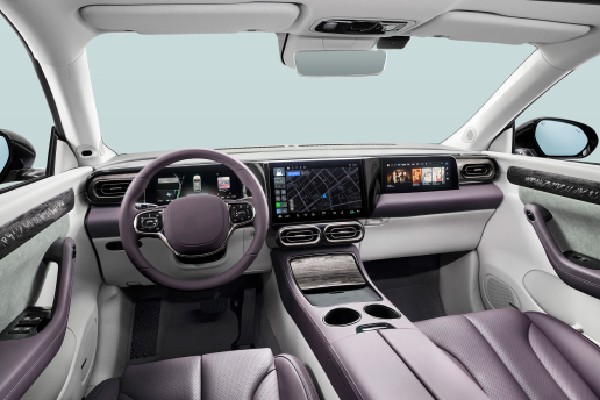
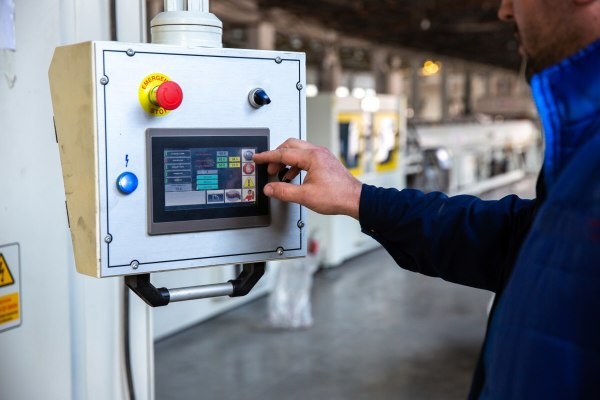
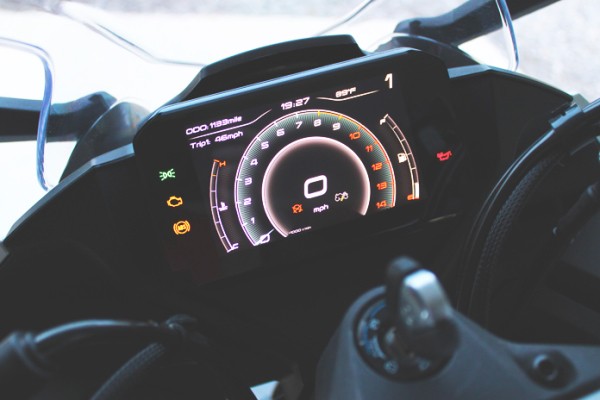
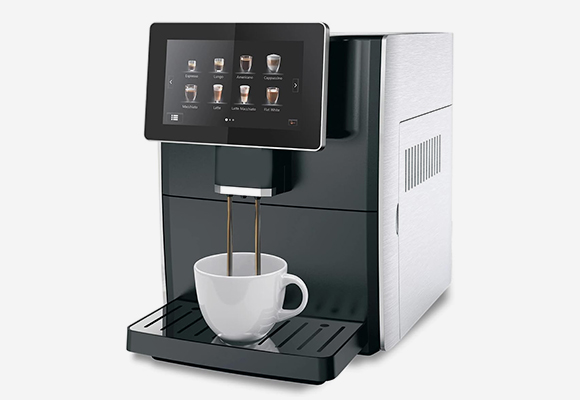
The 3.4 inch round TFT LCD with integrated capacitive touch is designed for compact, modern interfaces where traditional rectangular displays are not suitable. With its 800×800 resolution, MIPI interface, and G+G touch structure, this round touch display is widely used in the following applications:
Ideal for thermostats, HVAC controllers, and central home automation systems, where a round TFT LCD enhances product aesthetics while maintaining intuitive touch interaction.
Suitable for coffee machines, ovens, and high-end appliances that require a compact 3.4 inch round LCD with responsive touch and a clean UI design.
Used in light industrial equipment and embedded control panels, where a round touch display enables space-efficient HMI integration without compromising usability.
Perfect for smart hubs, sensors, and connected devices that need a visually distinctive round TFT LCD module with multi-touch capability.
Applicable in portable diagnostic equipment and wearable-adjacent devices, where compact size, stable touch, and clear display performance are required.
![]() | ![]() | ![]() | ![]() |
![]() | ![]() | ![]() | ![]() |
![]() | ![]() | ![]() | ![]() |
To support different integration requirements across industrial, medical, and embedded systems, FANNAL provides flexible customization services for display, touch, and optical bonding.
Size range: 1.77" – 15.6"
Panel partners: BOE, Innolux, JDI, Hannstar, CTC, TCL, Tianma
Panel technologies: IPS / TN / LTPS
Operating temperature options
Industrial: –20°C ~ 70°C
Automotive: –30°C ~ 85°C
Custom FPC shape, length, and pin definition
Interface support: SPI / MCU / RGB / MIPI / LVDS / eDP
Optional signal conversion for different host platforms
EMI shielding and circuit optimisation for stable signal transmission
Structure materials: metal / plastic / hybrid metal-plastic
Brightness options: standard to ultra-high brightness
Maximum brightness: up to 3000 cd/m² (sunlight readable)
Backlight lifetime: up to 50,000 hours
Interface options: RGB / VGA / HDMI / LVDS / DVI / Type-C
Compatible with custom TFT LCD modules
Optimised design for stable image transmission and long-term reliability
Available sizes: up to 65 inches
Sensor structures: G+G / G+F+F
Designed for industrial and automotive environments
Supported touch features:
Multi-touch
Glove touch
Passive stylus
Gesture control
Palm rejection
Operating temperature options:
Industrial: –20°C ~ 70°C
Automotive: –30°C ~ 85°C
Supported IC partners: EETI, ILITEK, Goodix, FocalTech, Cypress, Microchip
FANNAL in-house firmware tuning and touch optimisation
Excellent anti-interference capability
Designed for long-term industrial stability
EMC engineering support for EMI/RFI compliance
Material options:
Glass: 0.55 – 10.0 mm
PMMA: 0.5 – 3.0 mm
PC: 0.1 – 1.0 mm
Custom cover design:
CNC processing
Hot bending
2.5D / 3D cover glass
Ceramic printing
PMMA integrated structures
Surface treatments available:
AG / AR / AF (3A optical treatments)
Anti-microbial coating
Anti-explosion reinforcement
FANNAL provides multiple optical bonding technologies to improve display readability, durability, and environmental reliability.
Bonding Method | Supported Size | Features |
|---|---|---|
OCA | Up to 15.6" | Two fully automated production lines for high-volume manufacturing |
LOCA / OCR | Up to 32" | Excellent optical clarity and improved contrast |
Silicone Bonding | Up to 32" | Ideal for rugged and large industrial displays |
Optical bonding helps:
Improve sunlight readability
Reduce internal reflection
Increase impact resistance
Enhance long-term reliability
FANNAL, founded in 2011, is a specialist in touch display solutions, delivering high-quality products and technical services worldwide. We design and manufacture in-house custom Displays, PCAP touch screens, and optical bonding. Our solutions serve industrial, outdoor, medical, automotive and other applications.
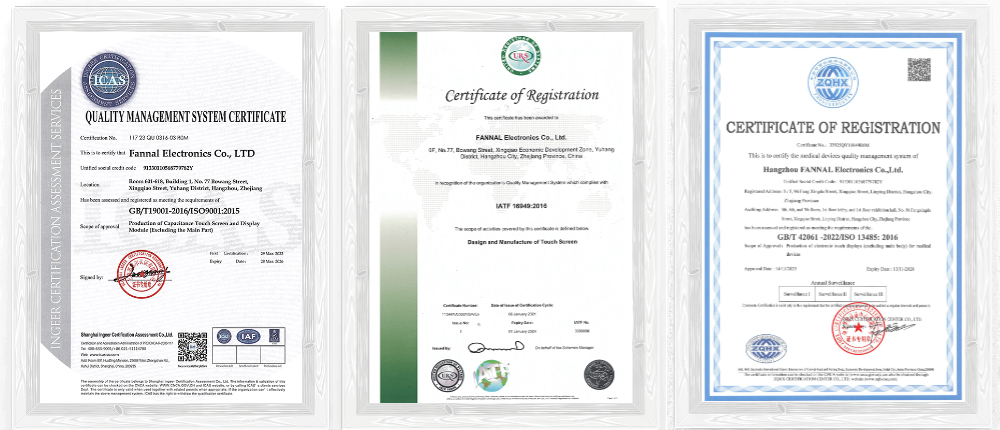
We are a fast-growing high-tech company financially backed by SECO, a European leader in electronic devices and embedded computing. We hold ISO 9001, ISO 14001, ISO 45001, ISO 13485, and IATF 16949 certifications. Our products are REACH and RoHS compliant, with test reports or declarations available upon request.
With stable quality and engineering support, FANNAL helps customers stay competitive and differentiate their products globally.
| Well-Experienced: 15 years of experience in TFT Displays, AMOLED Displays, Touch Displays, Capacitive Touchscreens, and Touch Monitors manufacturing. |
| One-Stop Solution: Full in-house process for touch screen, display, and optical bonding |
| Global Service: Italy, Germany, France, Spain, India, Japan, Singapore, and more — timely local support. |
| Strong Background: Financially backed by SECO, a top European leader in embedded and display solutions. |
| Reliable Supply: Our long-term supplier network ensures you receive consistent quality and reliable delivery, even in high-demand seasons. |
| Quality Assurance: ISO 9001, ISO 14001, ISO 45001, ISO 13485 & IATF 16949 certified; REACH & RoHS compliant. |
This round TFT LCD is not ideal for direct sunlight environments. With a typical brightness of 550 nits, it is better suited for indoor or semi-outdoor applications. For outdoor use, higher brightness (≥1000 nits) and additional optical enhancements such as anti-reflection coating are typically required to ensure visibility.
A round touch display offers superior design flexibility and visual differentiation. It enables circular UI layouts, making it ideal for applications like smart home controls and appliances. While rectangular displays maximize content area, round TFT LCDs are preferred where aesthetics, brand identity, and intuitive rotary-style interaction are important.
Yes, this round TFT LCD can be customized based on application requirements. Common options include cover glass thickness, surface treatments (AG/AF/AR), brightness adjustment, and interface tuning. For specific projects, mechanical structure and touch sensitivity can also be optimized to match different industrial or embedded system needs.
UI design for a round TFT LCD should prioritize circular layouts and content hierarchy. Unlike rectangular displays, corners are not available, so designers must avoid placing critical information near edges. Optimizing icon placement, font scaling, and touch zones ensures better usability and improves the overall experience of a round touch display.
Optical bonding significantly enhances display clarity and durability. By eliminating the air gap between the TFT and cover glass, it reduces internal reflections and improves contrast. For a round TFT LCD, this also increases structural strength and minimizes condensation risks, making it more reliable in demanding environments.
MIPI interface requires compatibility with the host processor. It is commonly used in high-speed embedded systems such as ARM-based platforms. However, designers must ensure that their MCU or SoC supports MIPI DSI. If not, additional bridge ICs or alternative interfaces may be required for proper integration.