FN0350D019C
3.5
-20~70
-30~80
320x480
ALL
SPI & RGB 18bit
700
Customizable
| Availability: | |
|---|---|
| Quantity: | |

General Specifications:
LCD size(inch): | 3.5 (Diagonal) |
Resolution: | 320(H)×480(V) |
Pixel Pitch: | 0.153(H)x0.153(V) |
Active Area(mm): | 48.96(H)×73.44(V) |
Module Size(mm): | 53.16(W)x81.74(H)×2.1(D) |
Display Mode(mm): | Normally Black |
Interface: | SPI & RGB 18-bit |
Pixel arrangement: | RGB-Vertical Stripe |
View Direction: | ALL |
Power Supply(V): | 2.8 |
Weight(g): | 20(Typ.) |
Luminance(cd/m2): | 500(Typ.) |
Operating Temperature(°C): | -20~+70 |
Storage Temperature(°C): | -30~+80 |
Interface:
| Pin No. | Symbol | Description | |||||
1 | GND | Ground. | |||||
2-3 | VDD | Power supply. | |||||
4 | IM2 | -The interface mode select. | |||||
5 | IM1 | -The interface mode select. | |||||
6 | IM0 | -The interface mode select. | |||||
7 | RESET | Global reset. Active low, Internal pull high. | |||||
8 | CS | Chip selection. | |||||
9 | DC | Serial interface clock. | |||||
10 | WR | Write enable in MCU parallel interface. | |||||
11 | RD | Read enable in 8080 MCU parallel . | |||||
12 | VSYNC | Vertical sync signal. | |||||
13 | HSYNC | Horizontal sync signal. | |||||
14 | DE | Data enable signal for RGB interface operation. | |||||
15 | DCLK | Pixel clock input pin. | |||||
16 | SDA | Serial in/out signal. | |||||
17-34 | D0-D17 | Data bus. | |||||
35 | LEDA | Power for LED backlight(Anode). | |||||
36-39 | LEDK | Power for LED backlight(Cathode). | |||||
40 | GND | Ground. | |||||
Electrical Characteristics:
| Parameter | Symbol | Min. | Typ. | Max. | Unit | Notes |
| Forward Current Voltage | VF | 2.8 | 3.0 | 3.3 | V | Note 1 |
| Forward Current | If | - | 160 | - | mA | |
| Backlight Power Consumption | Wbl | - | 0.48 | - | W | |
| LED Lifetime | - | 20000 | 30000 | - | Hrs | Note 2 |
This 3.5” IPS TFT display is well-suited for compact medical equipment where stable visibility and low power consumption are critical.
It fits applications such as handheld vital sign monitors, glucose meters, infusion pump controllers, and portable diagnostic tools used in clinical or ward environments.
The 500 cd/m² brightness ensures clear UI visibility under indoor lighting, while the IPS wide viewing angle allows operators to read data from different positions without color shift.
For embedded medical instruments requiring graphical UI rather than simple segment displays, the 320×480 resolution supports waveform display, menu navigation, and data visualization in a compact format.
The SPI & RGB 18-bit interface options provide flexibility for MCU-based or embedded Linux platforms, reducing integration complexity during device development.
Beyond medical usage, this module is also suitable for industrial handheld terminals, portable configuration tools, and compact control panels.
The -20°C to +70°C operating temperature range supports stable operation in factory and semi-outdoor environments, while the slim 2.1mm structure enables space-efficient product design.
For projects requiring consistent supply and stable design cycles, this display can be integrated into long-term industrial or medical programs, with customization options including touch integration and optical bonding available upon request.
To meet diverse integration needs, we offer extensive customisation for you, including:
• Size range: 1.77" to 15.6"
• Trusted panel partners: BOE, INNOLUX, JDI, Hannstar, CTC, TCL, and TIANMA.
• Panel types: IPS / TN / LTPS
• Operation Temperature: Industrial (-20 ~ 70°C), Automotive (-30 ~ 85°C)
• Tailored shape, length, and PIN definitions for full compatibility.
• EMI shielding and circuit optimisation.
• Supports multiple conversions: SPI, MCU, RGB, MIPI, LVDS, EDP
• Module material options: metal/plastic/metal–plastic integration
• High brightness up to 30,000 cd/m², ideal for outdoor or industrial use.
• Long lifetime up to 50,000 hours.
• Options: RGB / VGA / HDMI / LVDS / DVI / Type-C
• Fully compatible with custom TFT and LCD modules.
• Optimised design for stable image transmission and performance.

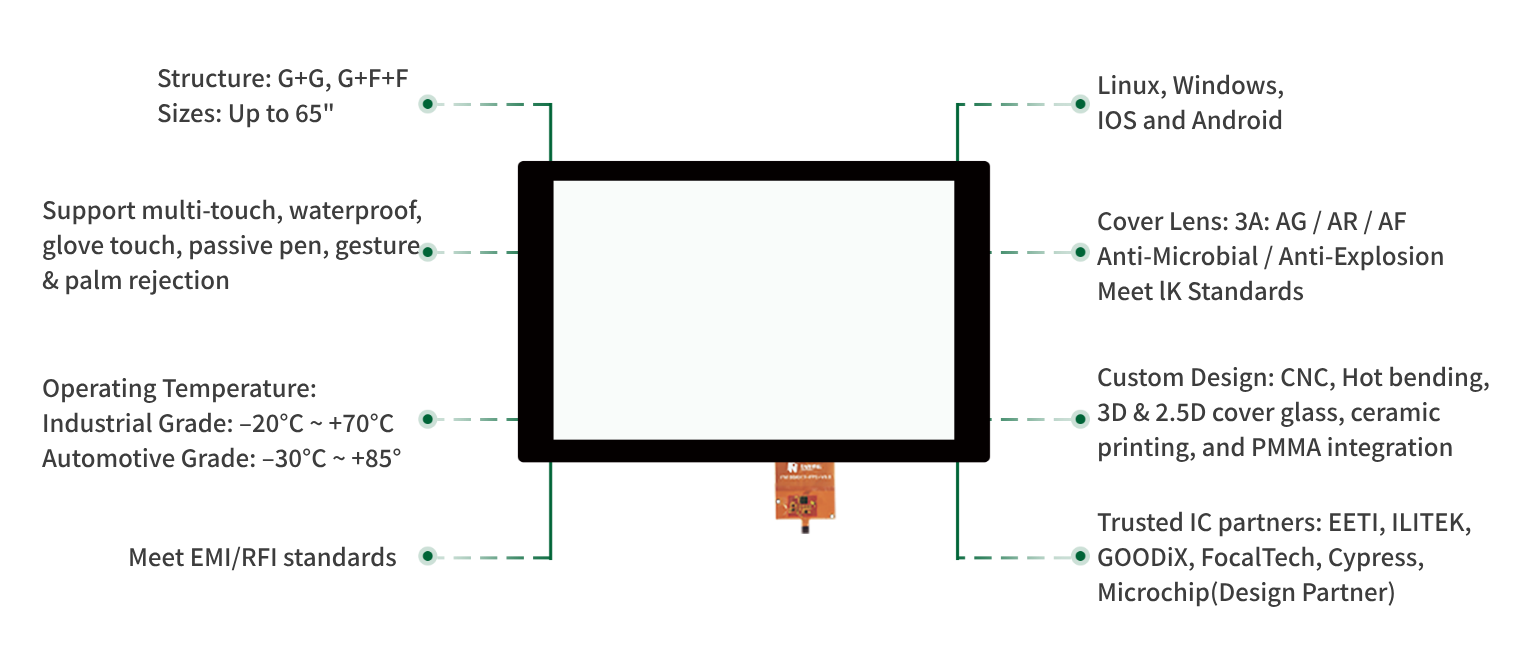
• Available Sizes: Up to 65"
• Structure Options: G+G, G+F+F, designed for industrial and automotive applications
• Touch Functions: Supports multi-touch, waterproof, glove touch, passive pen, gesture & palm rejection
• Operating Temperature:
Industrial Grade: –20°C ~ +70°C
Automotive Grade: –30°C ~ +85°
• Touch tuning and firmware optimization provided by FANNAL (in-house FW design)
• Trusted IC partners: EETI, ILITEK, GOODiX, FocalTech, Cypress, Microchip(FANNAL's Design Partner)
• High Reliability: Excellent anti-interference and long-term stability
• EMC Design: Full electromagnetic compatibility engineering to meet EMI/RFI and industrial standards
• Material Options:
Glass: 0.55mm–10.0mm
PMMA: 0.5mm–3.0mm
PC: 0.1mm–1.0mm
• Custom Design: CNC, Hot bending, 3D & 2.5D cover glass, ceramic printing, and PMMA integration
• Surface Treatments:
3A: AG / AR / AF
Anti-Microbial / Anti-Explosion
Optical Bonding | Size Range | Notes |
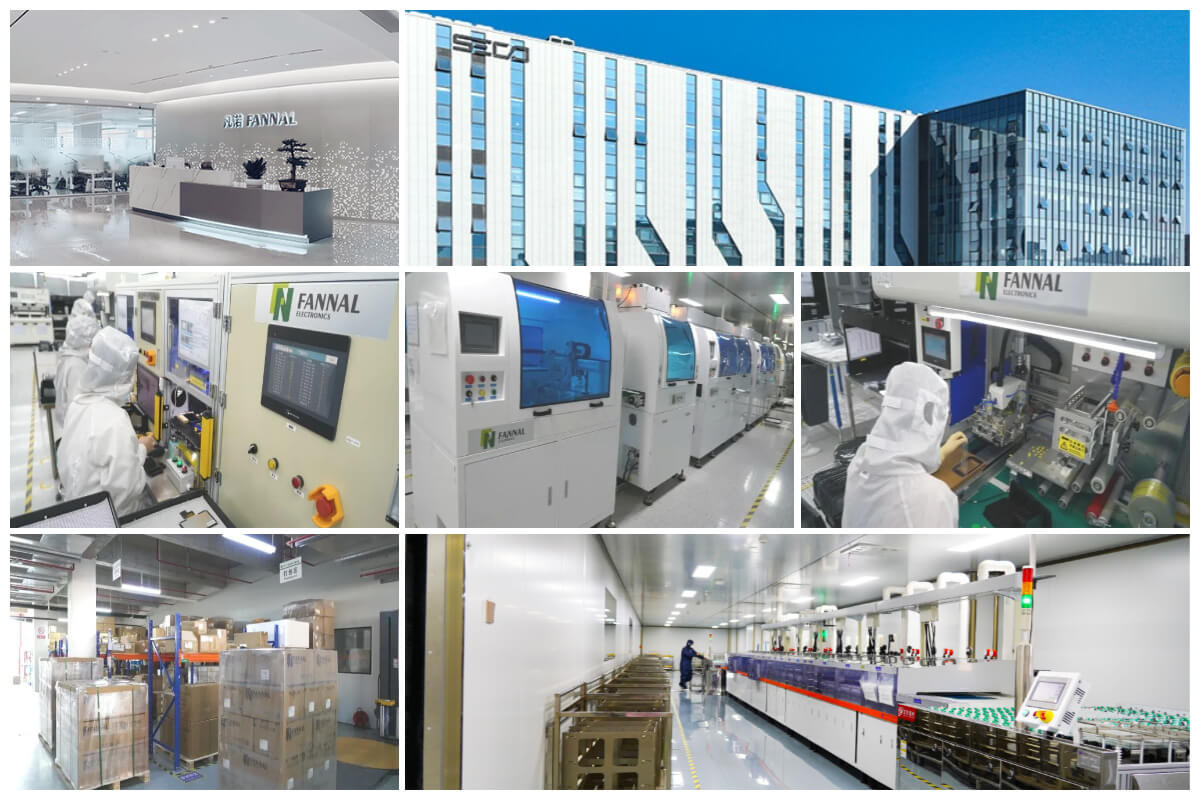
OCA | Up to 15.6” | Two fully automated production lines for high-volume manufacturing |
LOCA / OCR | Up to 32” | Excellent for high contrast and durability |
Silicone | Up to 32” | Ideal for rugged, large-size industrial applications |
In Italy, Germany, France, Spain, India, Japan, Singapore, and more — ensuring timely local support.

FAQ
Yes. This 3.5” IPS TFT module is positioned for industrial and professional equipment rather than consumer applications. It supports stable lifecycle management, making it suitable for medical handheld devices and embedded industrial systems that require long-term availability and design consistency.
Yes. The display can be integrated with capacitive or resistive touch panels depending on application requirements. Optical bonding and cover glass customization are also available to enhance durability and readability for medical or industrial environments.
SPI is suitable for low-pin-count MCU systems with limited bandwidth requirements, while RGB 18-bit interface is recommended for higher refresh performance and smoother graphical UI. Engineers should evaluate system memory, frame rate expectations, and controller compatibility during design selection.
Yes. Mechanical adjustments such as FPC design, connector position, and thickness optimization can be supported. Electrical customization including interface adaptation and backlight tuning may also be available depending on project volume and development timeline.
The display module itself is a component and does not carry medical device certification independently. However, it can be integrated into certified medical equipment systems depending on the overall device design and compliance requirements handled by the equipment manufacturer.