FN0520P003A
FANNAL
5.2
218.6(H) x 46.00(V) x 1.85(D)
-20~70
-30~80
129.16(H) x 35.91(V)
IIC
| Quantity: | |
|---|---|
No. |
Item |
Specifications |
Unit |
1 |
Touch Panel Size |
5.2 (Diagonal) |
inch |
2 |
Structure |
CTP |
|
3 |
View Area |
129.16(H) x 35.91(V) |
mm |
4 |
Outline Dimension |
218.6(H) x 46.00(V) x 1.85(D) |
mm |
5 |
Channels |
24 x 8 |
|
6 |
Resolution |
619 * 142 |
|
7 |
Operation Temperature |
-20 ~ 70°C |
|
8 |
Storage Temperature |
-30 ~ 80°C |
|
9 |
Transparency |
(Min) 85% |
|
10 |
Driver IC |
Goodix |
|
11 |
Detect Points |
10 |
|
12 |
Interface |
I2C |
|
13 |
Power Supply |
3.3V |
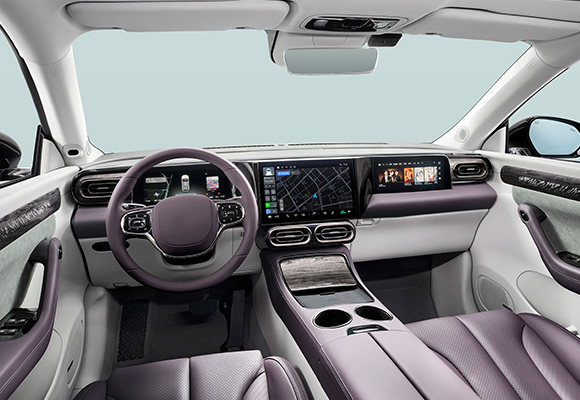
EV charger UI side panels (status + payment flow split UI)
Elevator COP / LOP narrow interfaces
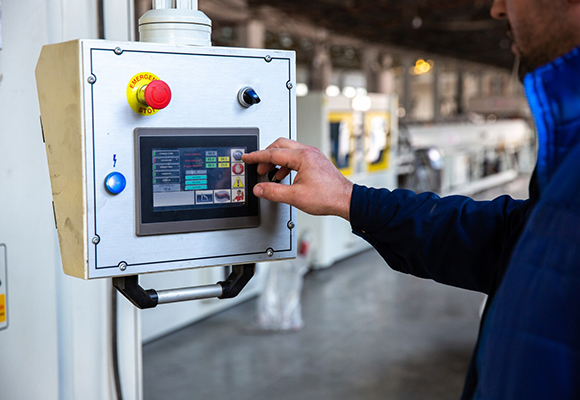
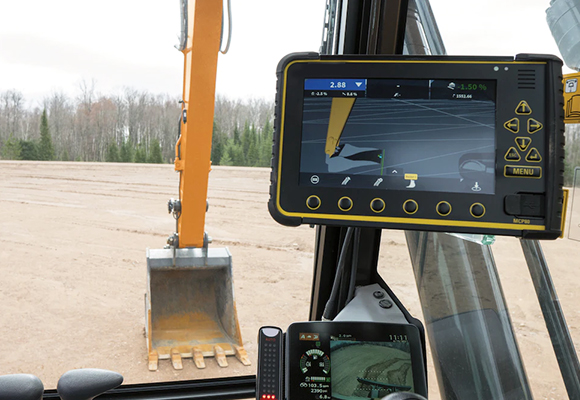
Industrial machine auxiliary control strips
Audio / broadcast control surfaces
Rail transit door / status indication panels
Smart building access + control terminals
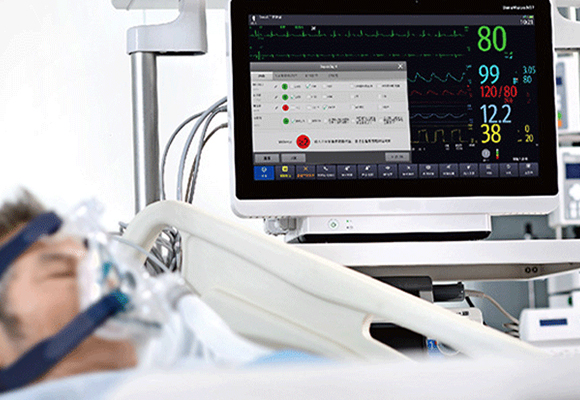
Medical equipment secondary control UI
Compact HMI modules in space-constrained enclosures
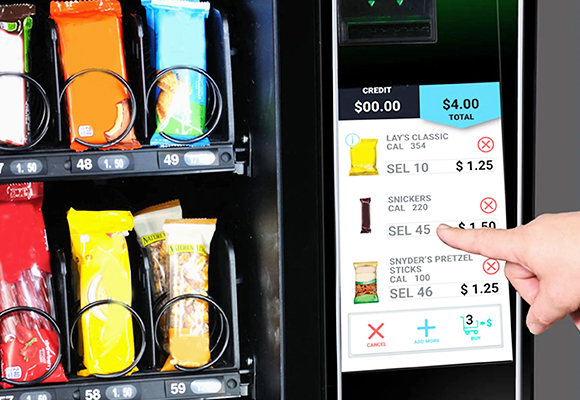
Retail shelf-edge interactive controls
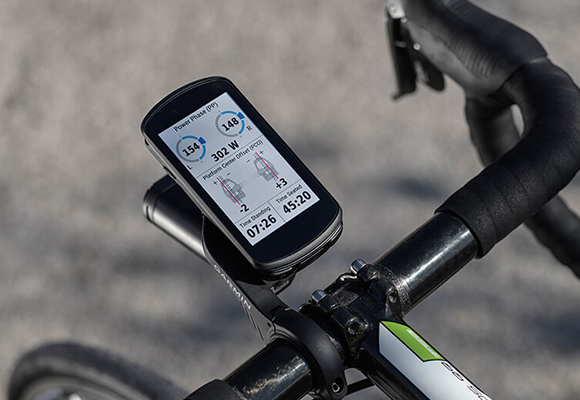
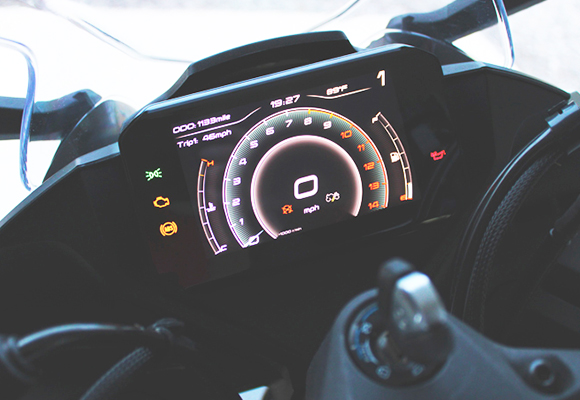
Custom embedded instrument panels
To meet diverse integration needs, we offer extensive customisation for you, including:
• Size range: 1.77" to 15.6"
• Trusted panel partners: BOE, INNOLUX, JDI, Hannstar, CTC, TCL, and TIANMA.
• Panel types: IPS / TN / LTPS
• Operation Temperature: Industrial (-20 ~ 70°C), Automotive (-30 ~ 85°C)
• Tailored shape, length, and PIN definitions for full compatibility.
• EMI shielding and circuit optimisation.
• Supports multiple conversions: SPI, MCU, RGB, MIPI, LVDS, EDP
• Module material options: metal/plastic/metal–plastic integration
• High brightness up to 30,000 cd/m², ideal for outdoor or industrial use.
• Long lifetime up to 50,000 hours.
• Options: RGB / VGA / HDMI / LVDS / DVI / Type-C
• Fully compatible with custom TFT and LCD modules.
• Optimised design for stable image transmission and performance.
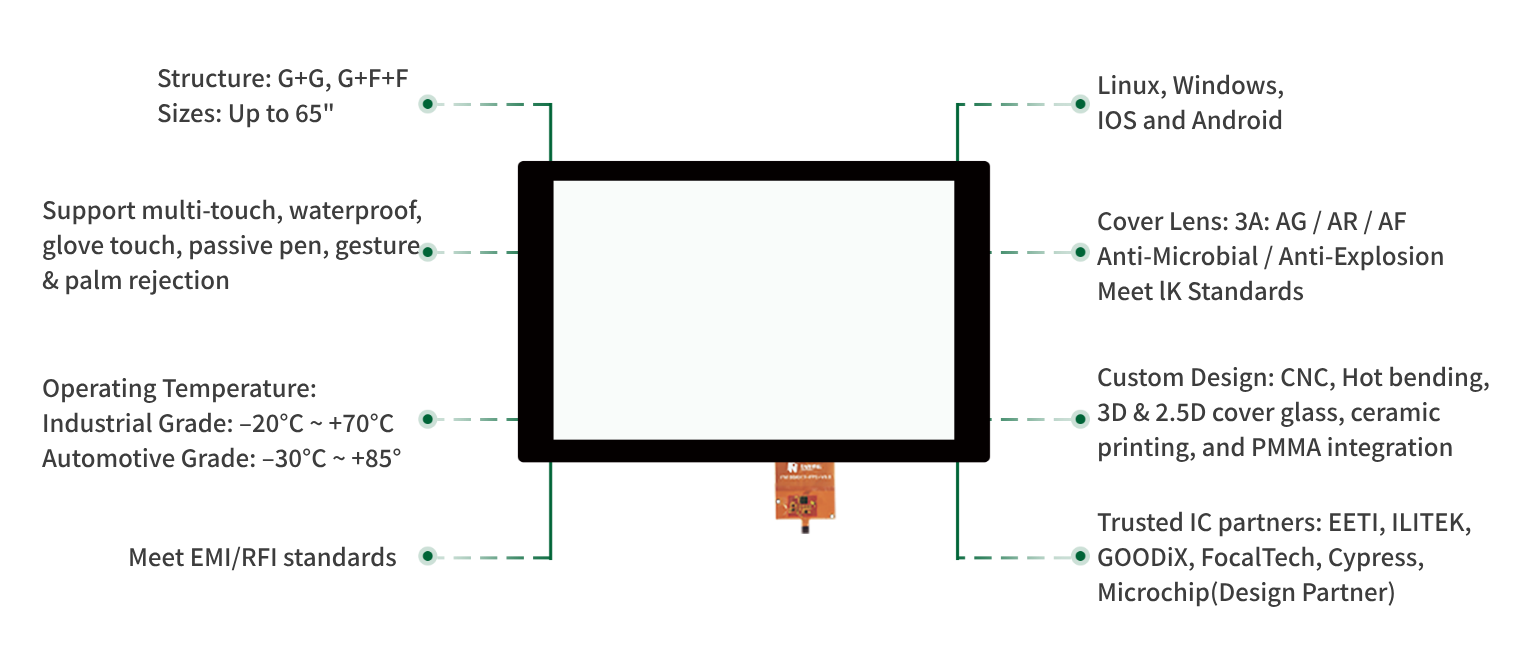
• Available Sizes: Up to 65"
• Structure Options: G+G, G+F+F, designed for industrial and automotive applications
• Touch Functions: Supports multi-touch, waterproof, glove touch, passive pen, gesture & palm rejection
• Operating Temperature:
Industrial Grade: –20°C ~ +70°C
Automotive Grade: –30°C ~ +85°
• Touch tuning and firmware optimization provided by FANNAL (in-house FW design)
• Trusted IC partners: EETI, ILITEK, GOODiX, FocalTech, Cypress, Microchip(FANNAL's Design Partner)
• High Reliability: Excellent anti-interference and long-term stability
• EMC Design: Full electromagnetic compatibility engineering to meet EMI/RFI and industrial standards
• Material Options:
Glass: 0.55mm–10.0mm
PMMA: 0.5mm–3.0mm
PC: 0.1mm–1.0mm
• Custom Design: CNC, Hot bending, 3D & 2.5D cover glass, ceramic printing, and PMMA integration
• Surface Treatments:
3A: AG / AR / AF
Anti-Microbial / Anti-Explosion
Optical Bonding |
Size Range |
Notes |
OCA |
Up to 15.6” |
Two fully automated production lines for high-volume manufacturing |
LOCA / OCR |
Up to 32” |
Excellent for high contrast and durability |
Silicone |
Up to 32” |
Ideal for rugged, large-size industrial applications |