FN070AM109-V2
FANNAL
7
166x101x7.85
154.21x85.92
-20~70
-30~80
155.21(H)x86.92(V)
G+G
1024x600
LVDS
I2C+USB
930
| Availability: | |
|---|---|
| Quantity: | |
The display uses full lamination (optical bonding) instead of air bonding. By eliminating the air gap between the touch panel and the TFT, internal reflections are reduced, helping improve perceived contrast and readability in bright environments. Optical bonding can also minimize the visual effect of condensation that may occur in changing temperature conditions.
The integrated touch display provides 930 nits typical brightness and 760 nits minimum brightness after touch integration.
The TFT panel itself delivers 1200 nits typical luminance, while the complete TPM brightness reflects the optical losses introduced by the cover glass, anti-glare treatment, touch sensor, and bonding materials. Evaluating TPM brightness rather than bare TFT brightness provides a more realistic indication of end-product performance.
The cover glass incorporates anti-glare treatment (70 ±15), helping diffuse reflected light from overhead lighting or outdoor ambient conditions. This can improve screen readability without relying solely on increased backlight output.
Powered by the Microchip mXT1664T3 touch controller, the display supports up to 10 simultaneous touch points. The maXTouch family is widely used in industrial and professional applications due to its stable touch performance and extensive integration experience across various operating systems.
The display supports operation from -20°C to +70°C and storage from -30°C to +80°C, making it suitable for equipment deployed in non-climate-controlled environments.
The TFT module is rated for a 50,000-hour typical LED lifetime, supporting applications that require extended operating periods and reduced maintenance intervals.
PROPERTY | Requirement |
STRCUTURE | G+G |
Bonding Type | Full lamination |
TOUCH IC | mxT1664T3 |
NO. OF TOUCH | 10 |
Coverglass Thickness | 1.1mm(Sodalime)+AG |
ITO Glass Thickness | 0.7mm |
Surface Hardness | ≥7H |
Light Transmittance | 85% Min |
Operating Temperature | -20~70° C |
Storage Temperature | -30~80° C |
TP+LCM BRIGHTNESS (MIN) | 760 cd/m² |
TP+LCM BRIGHTNESS (TYP) | 930 cd/m² |
High brightness and optical bonding help maintain screen visibility under varying daylight conditions, while projected capacitive touch supports intuitive user interaction.
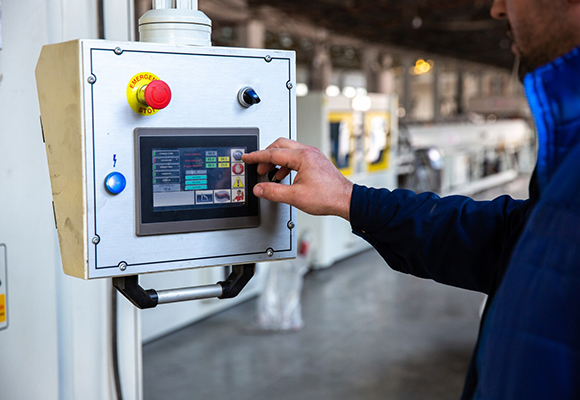
Suitable for industrial control equipment installed in outdoor cabinets, factory yards, or semi-exposed environments where display readability is important.
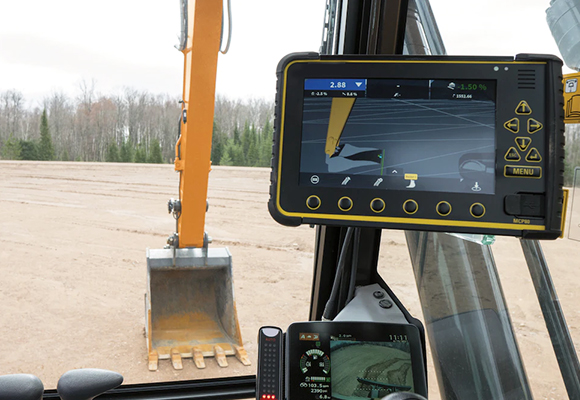
Can be integrated into tractor displays, agricultural automation systems, and operator interfaces exposed to changing ambient lighting conditions.
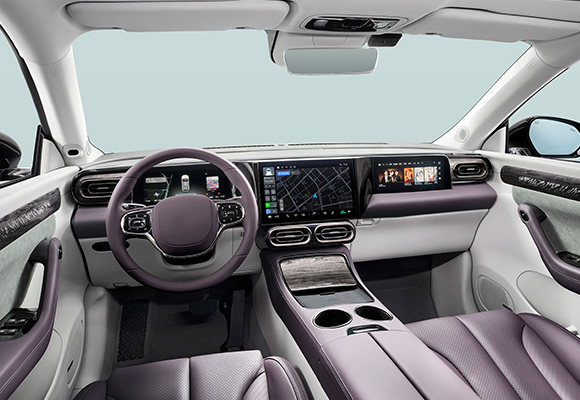
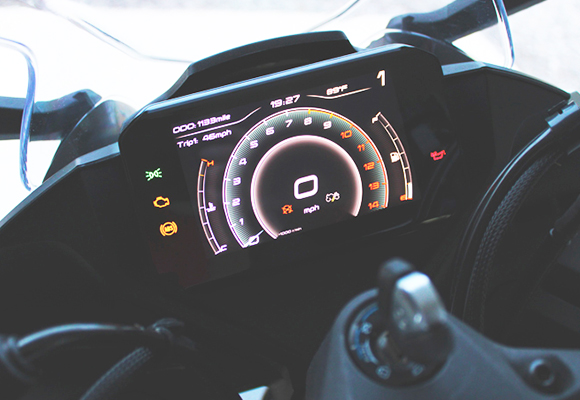
Applicable to onboard monitoring systems and control panels where reflections and varying light conditions may affect usability.
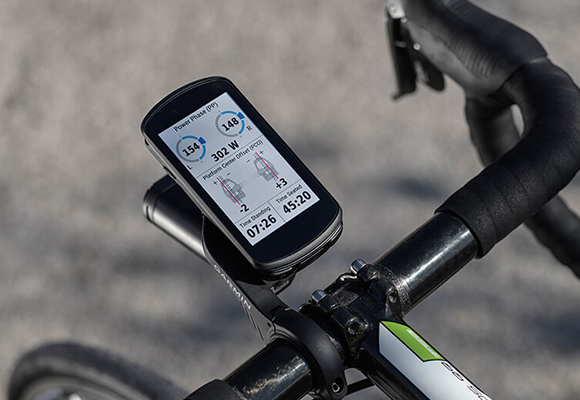
Useful for field instruments and portable equipment that require a combination of touch functionality and enhanced visibility in bright environments.
To meet diverse integration needs, we offer extensive customisation for you, including:
• Size range: 1.77" to 15.6"
• Trusted panel partners: BOE, INNOLUX, JDI, Hannstar, CTC, TCL, and TIANMA.
• Panel types: IPS / TN / LTPS
• Operation Temperature: Industrial (-20 ~ 70°C), Automotive (-30 ~ 85°C)
• Tailored shape, length, and PIN definitions for full compatibility.
• EMI shielding and circuit optimisation.
• Supports multiple conversions: SPI, MCU, RGB, MIPI, LVDS, EDP
• Module material options: metal/plastic/metal–plastic integration
• High brightness up to 30,000 cd/m², ideal for outdoor or industrial use.
• Long lifetime up to 50,000 hours.
• Options: RGB / VGA / HDMI / LVDS / DVI / Type-C
• Fully compatible with custom TFT and LCD modules.
• Optimised design for stable image transmission and performance.
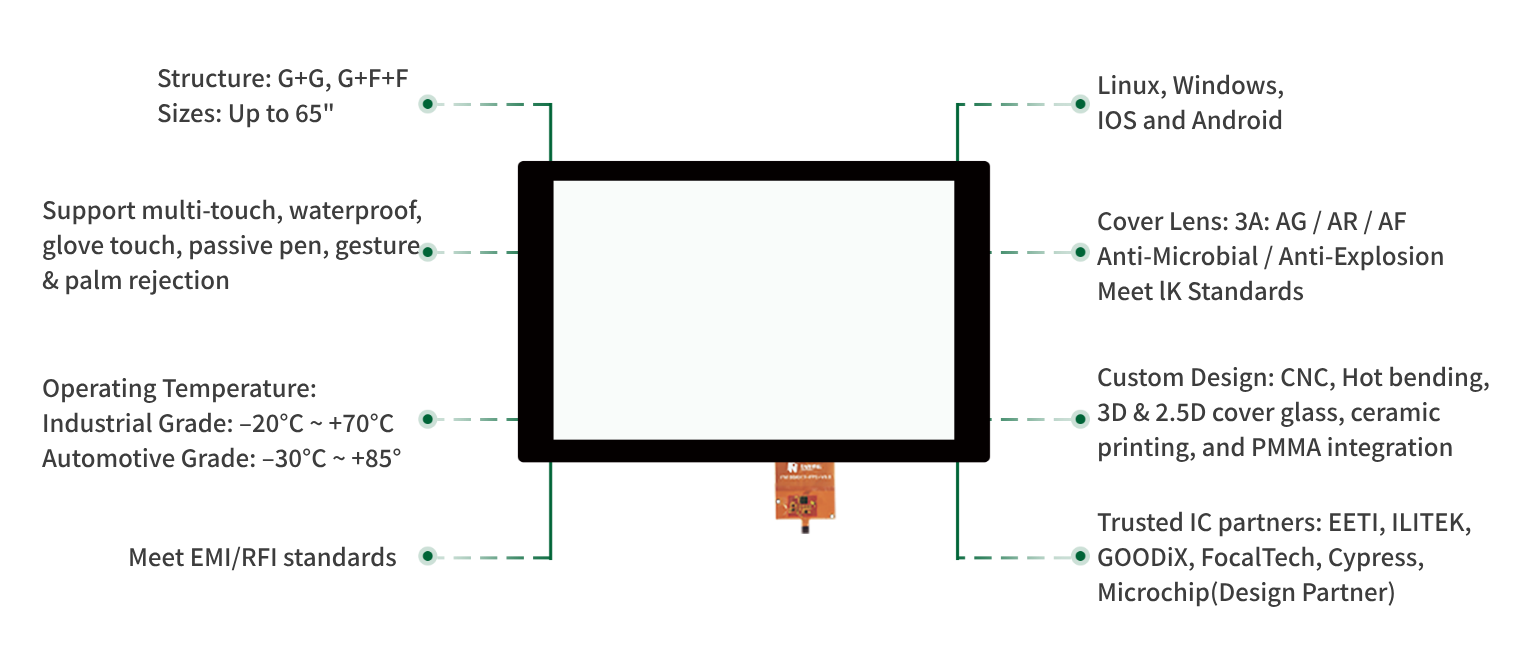
• Available Sizes: Up to 65"
• Structure Options: G+G, G+F+F, designed for industrial and automotive applications
• Touch Functions: Supports multi-touch, waterproof, glove touch, passive pen, gesture & palm rejection
• Operating Temperature:
Industrial Grade: –20°C ~ +70°C
Automotive Grade: –30°C ~ +85°
• Touch tuning and firmware optimization provided by FANNAL (in-house FW design)
• Trusted IC partners: EETI, ILITEK, GOODiX, FocalTech, Cypress, Microchip(FANNAL's Design Partner)
• High Reliability: Excellent anti-interference and long-term stability
• EMC Design: Full electromagnetic compatibility engineering to meet EMI/RFI and industrial standards
• Material Options:
Glass: 0.55mm–10.0mm
PMMA: 0.5mm–3.0mm
PC: 0.1mm–1.0mm
• Custom Design: CNC, Hot bending, 3D & 2.5D cover glass, ceramic printing, and PMMA integration
• Surface Treatments:
3A: AG / AR / AF
Anti-Microbial / Anti-Explosion
Optical Bonding | Size Range | Notes |
OCA | Up to 15.6” | Two fully automated production lines for high-volume manufacturing |
LOCA / OCR | Up to 32” | Excellent for high contrast and durability |
Silicone | Up to 32” | Ideal for rugged, large-size industrial applications |
The TFT panel provides 1200 nits typical luminance before touch integration. After adding the cover glass, anti-glare coating, touch sensor, and optical bonding materials, some light transmission loss occurs. The TPM brightness specification represents the actual performance of the completed touch display assembly.
In many outdoor and bright industrial environments, yes. However, readability depends not only on brightness but also on optical bonding, surface treatments, viewing angle, enclosure design, and ambient lighting conditions. Extremely demanding outdoor applications may require even higher brightness levels.
Optical bonding helps reduce internal reflections, improve perceived contrast, and minimize the appearance of condensation between the touch panel and display. These advantages are particularly valuable in bright environments.
Higher brightness alone does not eliminate reflections. Anti-glare treatment helps scatter reflected light from external sources, which can improve viewing comfort and readability in practical operating conditions.
Many industrial applications use only single-touch operation. However, multi-touch capability provides flexibility for gesture-based interfaces, future software updates, and applications where more advanced user interaction may be required.