FN0240D008A
FANNAL
2.4
36.72(H) x 48.96(V)
-20~70
-30~80
1500:1
240 x 320
Free / ALL
MCU & SPI-4W (4-line)
550
| Availability: | |
|---|---|
| Quantity: | |
This 2.4 inch TFT LCD module combines a compact footprint with a relatively bright backlight and wide viewing characteristics typically associated with IPS displays. Small displays are often selected because of mechanical constraints rather than display size itself, so interface options, viewing angle, and readability can become more important than resolution alone during system design.
Small screens are not always viewed straight on. In handheld equipment, compact control panels, or devices mounted at different angles, users often interact with the display from the side rather than directly in front of it.
With ALL viewing direction characteristics, the module maintains more consistent color and contrast behavior across different viewing positions. In practice, this often reduces the washed-out appearance seen in some traditional TN displays.
The module provides 550 nits typical brightness, which is above many standard compact TFT modules used in indoor environments.
Brightness alone does not determine readability, however. Reflections from the cover window, enclosure design, and ambient lighting can still influence the final user experience. For products installed near windows or stronger light sources, optical considerations can become just as important as luminance values.
Different platforms do not always use the same display architecture. Some projects prioritize lower pin count and simpler routing, while others focus on display update behavior and processor capability.
Supporting both MCU and SPI-4W interfaces allows the display to fit into different hardware environments without forcing a single communication approach.
The display uses a Normally Black mode together with a 1500:1 typical contrast ratio.
The difference may be more noticeable in graphical interfaces than in pure text applications. Dark backgrounds and graphical elements generally appear deeper and more defined compared with lower contrast structures.
The display includes an anti-glare surface treatment rather than relying entirely on brightness increases to improve visibility.
AG treatment and brightness solve different problems. Increasing brightness adds light output; anti-glare treatment attempts to manage reflected light from the surrounding environment.
Parameter | Specification | Unit |
LCD Size | 2.4 (Diagonal) | inch |
Resolution Ratio | 240(H) x 320(V) | pixels |
Pixel Pitch | 0.153 x 0.153 | mm |
Active Area | 36.72(H) x 48.96(V) | mm |
Module Size | 42.72(W) x 60.26(H) x 2.3(D) | mm |
Interface | MCU & SPI-4W (4-line) | - |
Power Supply | 2.8 | V |
Power Consumption | 0.5 (Typ.) | W |
Driver IC | ST7789V2 | - |
LCD Type | Transmissive | - |
Display Mode | Normally Black | - |
Color Depth | 65K | - |
Display Direction | Free / ALL | - |
Surface Treatment | Anti-Glare | - |
Luminance | 550 (Typ.) / 450 (Min.) | cd/m² |
Uniformity | 80% Min | - |
Contrast Ratio | 1500:1 | - |
Connection Mode | FPC Plug-in | - |
Operation Temp. | -20 ~ +70 | °C |
Storage Temp. | -30 ~ +80 | °C |
Weight | 12.0 (Typ.) | g |
Environmental | RoHS-2.0 | - |
Unmarked Tolerance | ±0.2 | mm |
Compact instruments often have limited front-panel space, while users may operate the display from changing positions or under varying lighting conditions.
Suitable for systems displaying status information, configuration menus, and basic graphical interfaces where physical space is limited.
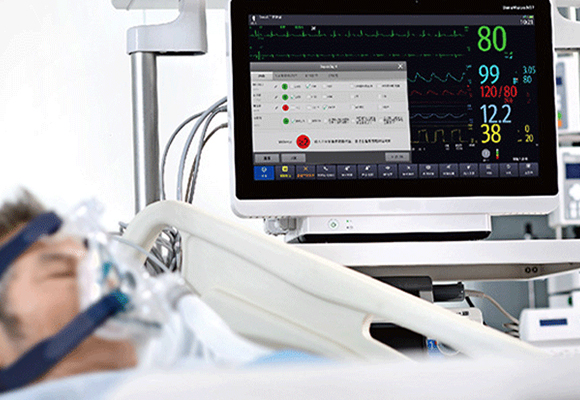
Can be integrated into smaller medical equipment requiring stable viewing behavior and consistent visual output.
Applicable to equipment requiring local display interaction without increasing overall product dimensions.
Can be used in embedded equipment where larger displays would create mechanical limitations or unnecessary power requirements.
To meet diverse integration needs, we offer extensive customisation for you, including:
• Size range: 1.77" to 15.6"
• Trusted panel partners: BOE, INNOLUX, JDI, Hannstar, CTC, TCL, and TIANMA.
• Panel types: IPS / TN / LTPS
• Operation Temperature: Industrial (-20 ~ 70°C), Automotive (-30 ~ 85°C)
• Tailored shape, length, and PIN definitions for full compatibility.
• EMI shielding and circuit optimisation.
• Supports multiple conversions: SPI, MCU, RGB, MIPI, LVDS, EDP
• Module material options: metal/plastic/metal–plastic integration
• High brightness up to 30,000 cd/m², ideal for outdoor or industrial use.
• Long lifetime up to 50,000 hours.
• Options: RGB / VGA / HDMI / LVDS / DVI / Type-C
• Fully compatible with custom TFT and LCD modules.
• Optimised design for stable image transmission and performance.
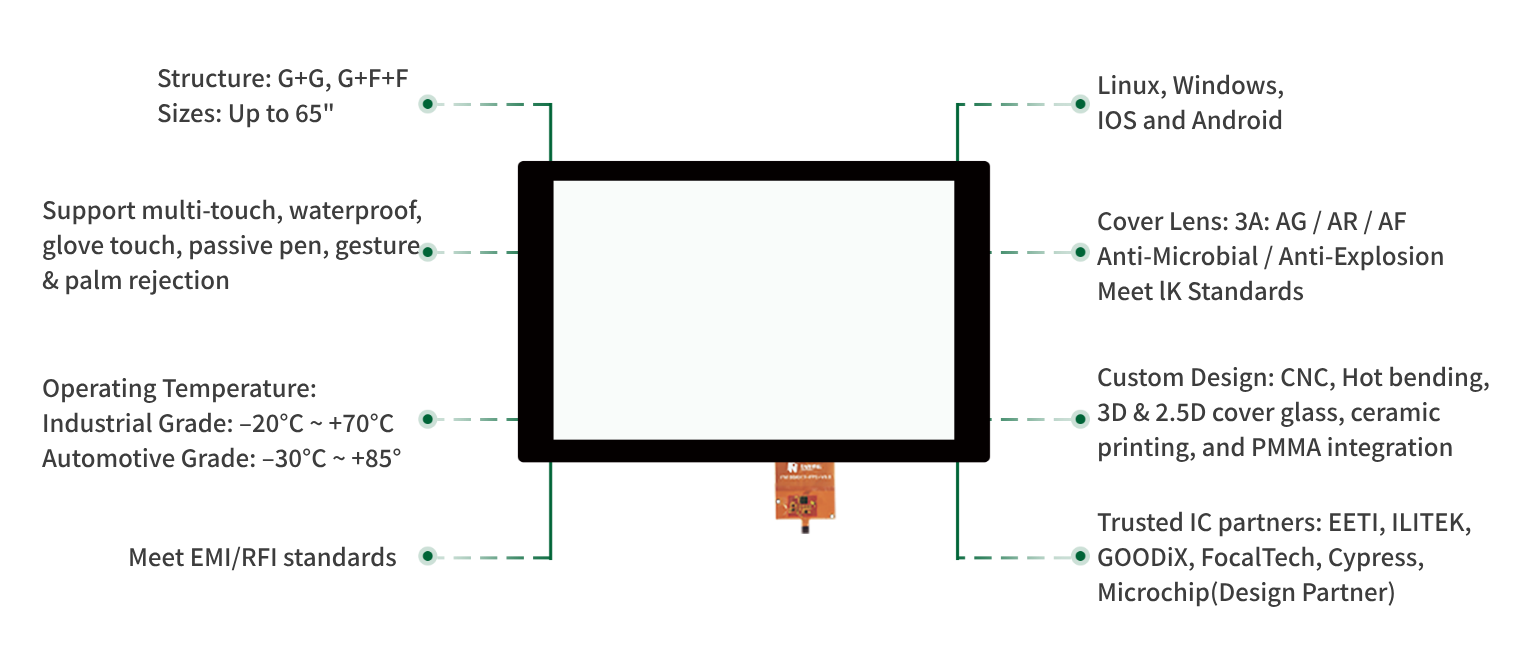
• Available Sizes: Up to 65"
• Structure Options: G+G, G+F+F, designed for industrial and automotive applications
• Touch Functions: Supports multi-touch, waterproof, glove touch, passive pen, gesture & palm rejection
• Operating Temperature:
Industrial Grade: –20°C ~ +70°C
Automotive Grade: –30°C ~ +85°
• Touch tuning and firmware optimization provided by FANNAL (in-house FW design)
• Trusted IC partners: EETI, ILITEK, GOODiX, FocalTech, Cypress, Microchip(FANNAL's Design Partner)
• High Reliability: Excellent anti-interference and long-term stability
• EMC Design: Full electromagnetic compatibility engineering to meet EMI/RFI and industrial standards
• Material Options:
Glass: 0.55mm–10.0mm
PMMA: 0.5mm–3.0mm
PC: 0.1mm–1.0mm
• Custom Design: CNC, Hot bending, 3D & 2.5D cover glass, ceramic printing, and PMMA integration
• Surface Treatments:
3A: AG / AR / AF
Anti-Microbial / Anti-Explosion
Optical Bonding | Size Range | Notes |
OCA | Up to 15.6” | Two fully automated production lines for high-volume manufacturing |
LOCA / OCR | Up to 32” | Excellent for high contrast and durability |
Silicone | Up to 32” | Ideal for rugged, large-size industrial applications |
Not always as a formal specification, but ALL viewing direction behavior is commonly associated with IPS or IPS-like display structures. Compared with conventional TN displays, wider viewing characteristics generally provide more stable image performance from different angles.
550 nits is higher than many standard indoor displays, but outdoor visibility depends on more than brightness alone. Reflections, cover materials, and direct sunlight conditions can significantly influence readability.
Projects sometimes evolve during development. A display interface that works well on one processor platform may not be ideal on another. Multiple interface options can simplify design changes later.
AG treatment diffuses reflected light and may slightly influence perceived image clarity depending on coating level. The goal is usually to improve practical readability rather than maximize optical clarity under controlled conditions.
Larger displays do not always improve usability. Mechanical space, power consumption, interface complexity, and viewing distance often affect the decision just as much as screen dimensions.