![What is a TFT Touch Screen?]()
TFT (Thin-Film Transistor) technology has revolutionized the way we view and interact with digital screens, especially in devices such as smartphones, tablets, televisions, and computer monitors. Known for their vibrant color reproduction, crisp images, and fast response times, TFT displays offer high-quality visuals. However, many people may wonder: Is TFT display technology the same as a touch screen?
In this article, we will delve into how TFT displays work, how they integrate with touch technology, and what makes TFT touch screens a preferred choice for modern devices. We will explore the different types of touch technology that can be combined with TFT screens, their advantages, and the various applications where this combination is commonly used.
What Is a TFT Display?
A TFT display is a type of LCD (Liquid Crystal Display) that uses thin-film transistor technology to control the individual pixels. Unlike older LCD technologies, which rely on passive matrix control, TFT displays use an active matrix system, meaning each pixel is controlled individually by a transistor. This results in sharper images, faster response times, better color accuracy, and overall higher resolution.
TFT displays are widely used in a variety of consumer electronics, such as:
Smartphones
Tablets
Laptops
Televisions
Monitors
HMI panels
Medical equipment
Automotive dashboards
Smart appliances
While TFT displays excel at providing high-quality images and vibrant colors, they don't inherently include touch functionality. However, by adding a touch-sensitive layer to a TFT display, it can be transformed into a TFT touch screen, enabling user interaction with the screen via touch.
How Do TFT Touch Screens Work?
A TFT touch screen combines the excellent display capabilities of a TFT screen with a touch-sensitive layer. This allows users to interact with the content displayed on the screen using their fingers or a stylus. The TFT display is responsible for showing the visuals, while the touch layer detects input from the user and sends this information to the device's processor.
There are several types of touch technology that can be integrated with TFT displays:
1. Capacitive Touch Technology
Capacitive touch screens are the most commonly used type in modern consumer electronics, such as smartphones, tablets, and laptops. Capacitive touch screens operate by detecting the electrical charge from the user's finger. When a finger touches the screen, it disrupts the electrical field on the surface, which the device’s sensor detects and interprets as touch input.
Capacitive screens are highly responsive, support multi-touch gestures (such as pinch-to-zoom), and are known for their durability. Their precise touch capabilities make them a popular choice for many modern devices.
2. Resistive Touch Technology
Resistive touch screens rely on pressure to detect touch. The screen consists of two layers separated by a small gap, and when you press on the screen, the layers make contact. This contact registers the touch, and the device responds accordingly. While resistive touch screens are not as sensitive or precise as capacitive ones, they can work with a finger, stylus, or even a gloved hand.
Resistive screens are typically used in applications that require durability or where the screen is likely to be used in harsh environments, such as industrial settings, kiosks, and medical devices.
3. Infrared Touch Technology
Infrared touch screens use an array of infrared sensors around the edges of the display. These sensors create an invisible grid of light beams that cover the screen. When a user touches the screen, the touch interrupts the light beams, allowing the device to detect the location of the touch.
Infrared screens offer excellent touch sensitivity and are highly durable. However, they tend to be bulkier than capacitive and resistive screens, making them more suitable for large touch screens such as those found in self-service kiosks or interactive displays.
Benefits of TFT Touch Screens
The combination of TFT display technology with touch capabilities offers numerous advantages, making TFT touch screens a popular choice in various industries. Here are some key benefits:
1. Enhanced User Interaction
TFT touch screens enable users to interact directly with the content on the screen, providing a more engaging and intuitive experience. This hands-on interaction is much more natural than using a mouse, keyboard, or remote control, making the experience feel more personal and immediate.
Whether you're swiping to scroll through a gallery, zooming in on a map, or tapping to select options in an app, the ability to touch the screen transforms how users engage with the device.
2. Improved Accessibility and Convenience
Touch screens make devices more accessible and user-friendly. In contrast to traditional input methods like keyboards or buttons, which can be difficult to navigate for some users, touch interfaces are more intuitive and easier to use for people of all ages. From seniors to young children, anyone can use a touch screen with minimal effort.
Additionally, touch screens can eliminate the need for physical buttons, reducing wear and tear and contributing to a sleeker, more streamlined design.
3. Space-Saving Design
Incorporating touch technology into TFT screens allows devices to have fewer physical buttons or input devices. This makes them ideal for applications where space is limited, such as smartphones, tablets, and handheld devices. The compact design of touch screen devices is not only more aesthetically pleasing but also more practical for portability.
4. Multi-Touch and Gesture Support
Modern TFT touch screens, especially those using capacitive touch technology, can support multi-touch gestures. This means users can interact with the device using multiple fingers simultaneously, allowing for more complex tasks like pinch-to-zoom, rotating images, and other gestures that make the user experience more dynamic and fluid.
This functionality is especially useful for applications like image editing, gaming, and browsing, where multi-finger gestures can enhance the overall interaction.
Common Applications of TFT Touch Screens
With the advancement of high-brightness technology, wide-temperature TFT modules, and optical bonding, TFT touch screens have become essential in a wide range of industrial and commercial devices. These displays deliver stable performance, outdoor visibility, and long-term reliability, making them suitable for demanding B2B environments. Below are key application categories aligned with modern industrial requirements:
TFT touch screens are widely integrated into HMI panels, PLC control terminals, machinery dashboards, and factory automation consoles.
Features such as wide operating temperature (−20°C to +70°C), anti-glare cover glass, and optical bonding ensure stable visibility and durability in harsh manufacturing environments with vibration, dust, or strong light.
2. Medical & Laboratory Devices
Medical equipment requires high clarity and long product life cycles.
TFT touch screens are commonly used in patient monitors, diagnostic systems, handheld analyzers, and infusion pumps.
With high contrast IPS panels, anti-bacterial coatings, and touch accuracy, these displays support precise operation in clinical environments.
3. Outdoor Terminals & Rugged Devices
Applications include outdoor kiosks, ticketing machines, charging stations, and rugged handhelds.
High-brightness TFT displays (up to 1000–1500 cd/m²), UV-resistant materials, and ruggedized cover glass make them ideal for long-term outdoor use under direct sunlight.
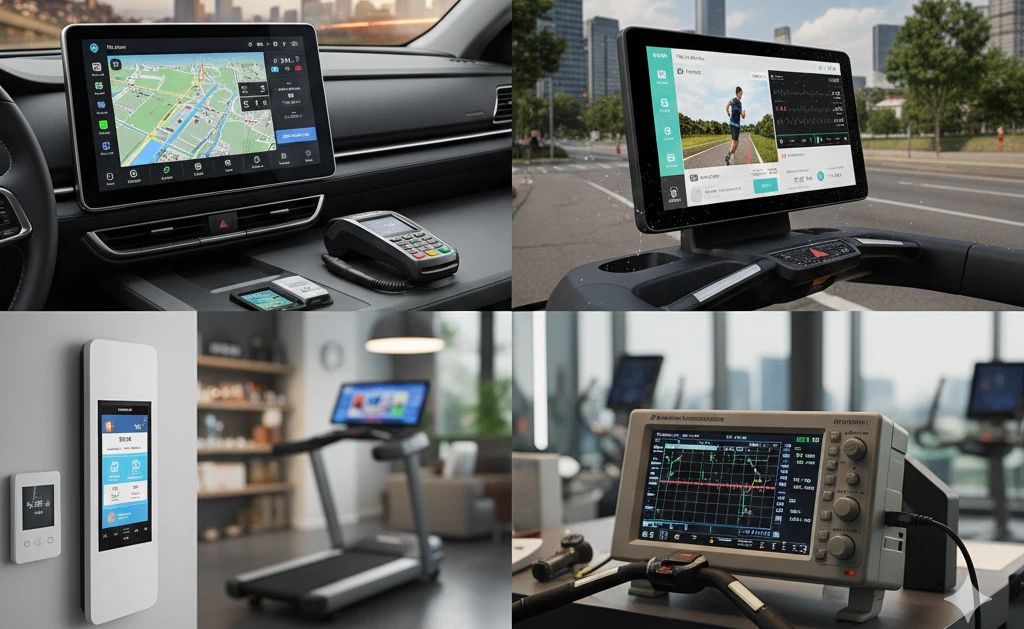
4. Transportation, Automotive, and Mobility
TFT touch screens are heavily used in:
Automotive center control systems
Motorcycle dashboards
E-bike and e-scooter displays
Marine and aviation equipment
The focus is on wide viewing angles, shock resistance, EMC performance, and sunlight readability to ensure safety and visibility in motion.

5. POS, Commercial Terminals & Smart Retail
Touch-enabled TFT displays are common in POS devices, handheld payment terminals, ordering systems, and vending machines.
The fast-response touch panel and durable cover glass support high-frequency daily operation in retail and hospitality environments.
6. Smart Home & Building Automation
Home control panels, wall-mounted thermostats, intercom systems, and security terminals widely adopt TFT touch displays for intuitive user interaction.
Slim design, customizable capacitive touch, and long-term availability make them suitable for OEM/ODM smart home systems.
7. Fitness, Healthcare & Gym Equipment
Treadmills, spinning bikes, rehabilitation equipment, and commercial gym consoles increasingly integrate TFT touch screens.
High durability, sweat-resistant coatings, and multi-touch gesture support enhance the interactive experience during use.
8. Test & Measurement Instruments
Oscilloscopes, spectrum analyzers, industrial testers, and handheld detectors rely on TFT touch screens for data visualization.
Industrial-grade TFTs provide long-term supply, stable color performance, and touch precision, supporting professional measurement environments.
Conclusion
TFT touch screens combine high-quality display technology with interactive touch functionality, offering users a seamless, intuitive, and engaging experience. Whether you're using a smartphone, tablet, or self-service kiosk, these touch screens make device interaction more natural and efficient. The integration of touch functionality into TFT displays enhances user interaction, saves space, supports multi-touch gestures, and improves accessibility, making them an essential part of modern devices.
As technology evolves, TFT touch screens are expected to become more prevalent, opening new possibilities across industries. By incorporating advanced TFT touch technology, devices can achieve superior performance, reliability, and user satisfaction. This makes TFT touch screens a key component in the future of technology, enhancing both functionality and user experience in countless applications.
FAQ
1. What is a TFT touch screen?
A TFT touch screen is a TFT LCD combined with a touch panel, allowing users to view content and interact with the device through touch.
2. What types of touch technology are commonly used?
Mainly capacitive touch (PCAP) and resistive touch, depending on the application requirements.
3. Can TFT touch screens be used outdoors?
Yes, as long as they feature suitable brightness, optical bonding, and protective cover glass.
4. Are custom sizes or cover glass designs available?
Yes, OEM/ODM customization is available for dimensions, touch type, cover glass, and interfaces.
5. Do TFT touch screens support industrial environments?
Industrial-grade models support wide operating temperatures and long-term reliability for harsh conditions.